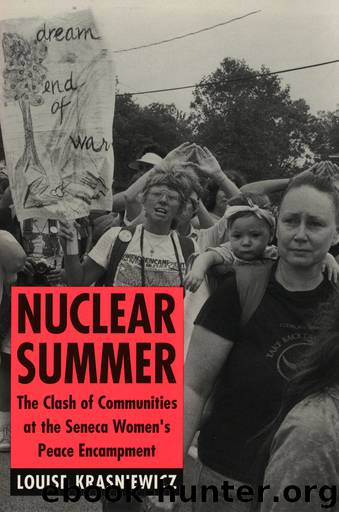
Nuclear Summer by Louise Krasniewicz
Author:Louise Krasniewicz
Language: eng
Format: epub
Publisher: Cornell University Press
Published: 2017-09-23T00:00:00+00:00
Between the ritual processes of separation and reintegration, the encampment offered participants an opportunity to pass through a state of liminality as well, a state of transition and reflection. As Victor Turner notes, in the liminal state participants in ritual “are withdrawn from their structural positions and consequently from values, norms, sentiments and techniques associated with these positions. They are also divested of their previous habits of thought, feeling and action. During the liminal period, neophytes are alternately forced or encouraged to think about their society, their cosmos, and the powers that generate and sustain them” (1969:105). During this part of the ritual people seem to “be themselves” as they drop all the pretenses and rules of everyday life. At the encampment, women were encouraged to put aside the regular roles they used for life in the patriarchy and were asked to live an alternative life based on female principles. The women of the encampment, like all who are placed in the liminal state, spent much of their time in reflection about the system that had brought them to this place. This reflectiveness was encouraged through daily protests and discussions and through workshops on topics ranging from nuclear weapons production to nonviolence, herbal medicine, homophobia, and racism. Through these workshops participants could evaluate the established society and compare it to the alternative world represented by the encampment.
Because the liminal state places people “betwixt and between the positions assigned and arranged by law, custom, conventions, and ceremonial,” those who are experiencing this liminal state are “necessarily ambiguous, since this condition and these persons elude or slip through the network of classifications that normally locates states and positions in cultural space” (Turner 1969:95). Turner has shown that in the liminal state, as opposed to the established social condition, people tend to experience equality. Status, rank, and property are absent; participants are either naked or they dress uniformly. Sexual distinctions are minimized and personal appearance disregarded. The hallmarks of the liminal are sacredness, spontaneity, foolishness, simplicity and unselfishness (ibid.).
A workshop at the encampment
Download
This site does not store any files on its server. We only index and link to content provided by other sites. Please contact the content providers to delete copyright contents if any and email us, we'll remove relevant links or contents immediately.
| Africa | Americas |
| Arctic & Antarctica | Asia |
| Australia & Oceania | Europe |
| Middle East | Russia |
| United States | World |
| Ancient Civilizations | Military |
| Historical Study & Educational Resources |
Cat's cradle by Kurt Vonnegut(15356)
Pimp by Iceberg Slim(14508)
4 3 2 1: A Novel by Paul Auster(12393)
Underground: A Human History of the Worlds Beneath Our Feet by Will Hunt(12099)
The Radium Girls by Kate Moore(12028)
Wiseguy by Nicholas Pileggi(5786)
The Fire Next Time by James Baldwin(5446)
Perfect Rhythm by Jae(5404)
American History Stories, Volume III (Yesterday's Classics) by Pratt Mara L(5308)
Paper Towns by Green John(5191)
Pale Blue Dot by Carl Sagan(5008)
A Higher Loyalty: Truth, Lies, and Leadership by James Comey(4964)
The Mayflower and the Pilgrims' New World by Nathaniel Philbrick(4504)
The Doomsday Machine by Daniel Ellsberg(4490)
Killers of the Flower Moon: The Osage Murders and the Birth of the FBI by David Grann(4447)
The Sympathizer by Viet Thanh Nguyen(4390)
Too Much and Not the Mood by Durga Chew-Bose(4348)
The Borden Murders by Sarah Miller(4325)
Sticky Fingers by Joe Hagan(4199)
